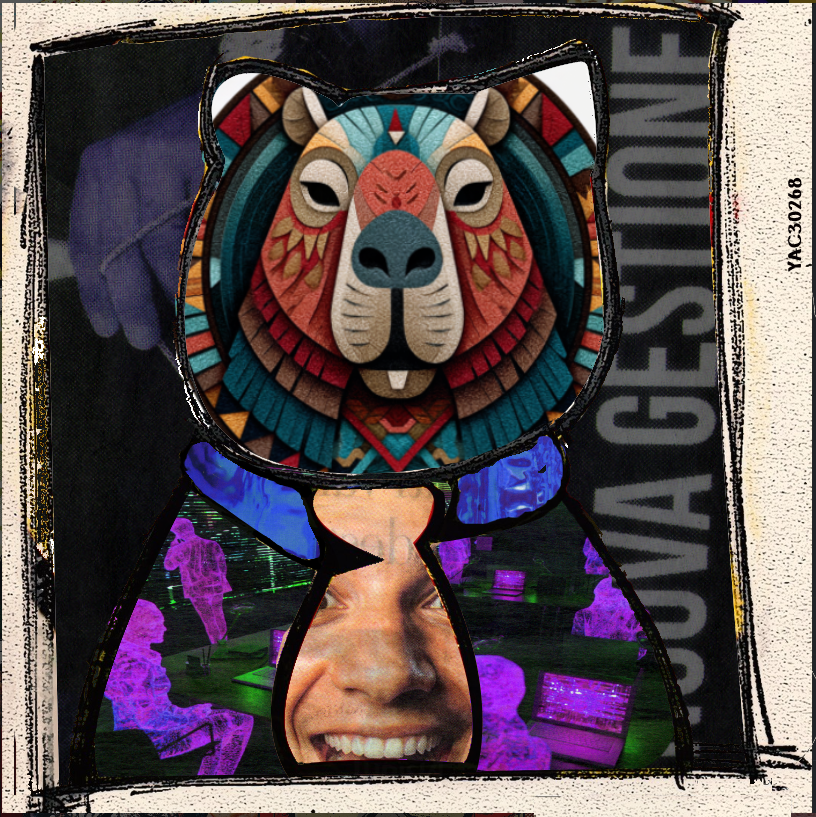
In Italy, the most interesting political idea of the moment is named after a large semi-aquatic rodent known for getting along with everyone. The Partito Capibara — the Capybara Party — is not yet a party in any formal sense, but it has a program, a technical team, a calendar of park gatherings, and a plan to collect 120,000 signatures before the 2027 elections.
The movement calls its doctrine gratuitismo: gratuitousness as a political position. The premise is disarmingly simple. Six basic human needs — housing, utilities, food, transport, healthcare, education — can be removed from market logic entirely and guaranteed as universal rights. What stands in the way is not scarcity but distribution.
The housing argument is characteristic of the movement's method: locate the existing surplus, then call the crisis by its real name. Italy has more empty homes than people who need them. The housing emergency, the Capybaras say, is a distribution failure dressed as a scarcity problem.
"We already live in abundance. We have the resources to guarantee everyone a free life, but they are concentrated in few hands."
The theoretical frame is left accelerationism — specifically the tradition running from Nick Srnicek and Alex Williams (Inventing the Future, Verso 2015) to Aaron Bastani's Fully Automated Luxury Communism. The argument: automation and AI, redirected rather than resisted, could eliminate the compulsion to overwork. Srnicek himself eventually dropped the "accelerationism" label — "we don't just want everything to go faster; arguing for a shorter working week is arguing for people's lives to slow down" — but the architecture of the argument survives.
In Italy, these ideas arrived less through academic papers (most key texts were never translated) and more through meme pages. The Capybaras make no apology for this. They invoke Mark Fisher's concept of hyperstition — an idea powerful enough to manufacture its own reality — and describe their electoral campaign as "a decentralized propaganda operation." The goal is not to govern in 2027. The goal is to shift what is considered thinkable.
The technical backbone is provided by REPA (Reti di Progettazione Aperta), an open-source network of engineers, academics and managers who have produced detailed implementing decrees — costed, sequenced, distributional-impact modelled. The fiscal architecture shifts the tax burden from labor (currently up to 50% of income, almost entirely falling on workers) to rents and large estates.
Critics from the left raise two objections. First: Srnicek and Williams never show the causal chain between increased automation and increased poverty — without which the demand for a universal basic income has no political engine. Second: automation follows profit, not emancipation. If labor in lower-wage economies is cheaper than machines, the machines don't get built. Technology does not accelerate toward freedom on its own; it accelerates toward margins.
The capybara — that photogenic, unbothered South American rodent — became an internet symbol for radical tolerance and communal ease. It coexists with monkeys, ducks, crocodiles. The party chose well. Whether the emblem translates into 120,000 signatures is a different question.